
Congratulations, you received your trademark registration. After spending more than a year going through the application process, it can feel like the process is finally over. You waited for the United States Patent and Trademark Office (USPTO) to review your application, and now you finally have your trademark registration. The part many business owners do not realize is that there are still things you need to do to keep that registration active.
A trademark registration can potentially last forever as long as you continue using the trademark and complete the required filings with the USPTO. You do not have to renew it every year, but there are a few important deadlines you should know from the day your trademark is registered.
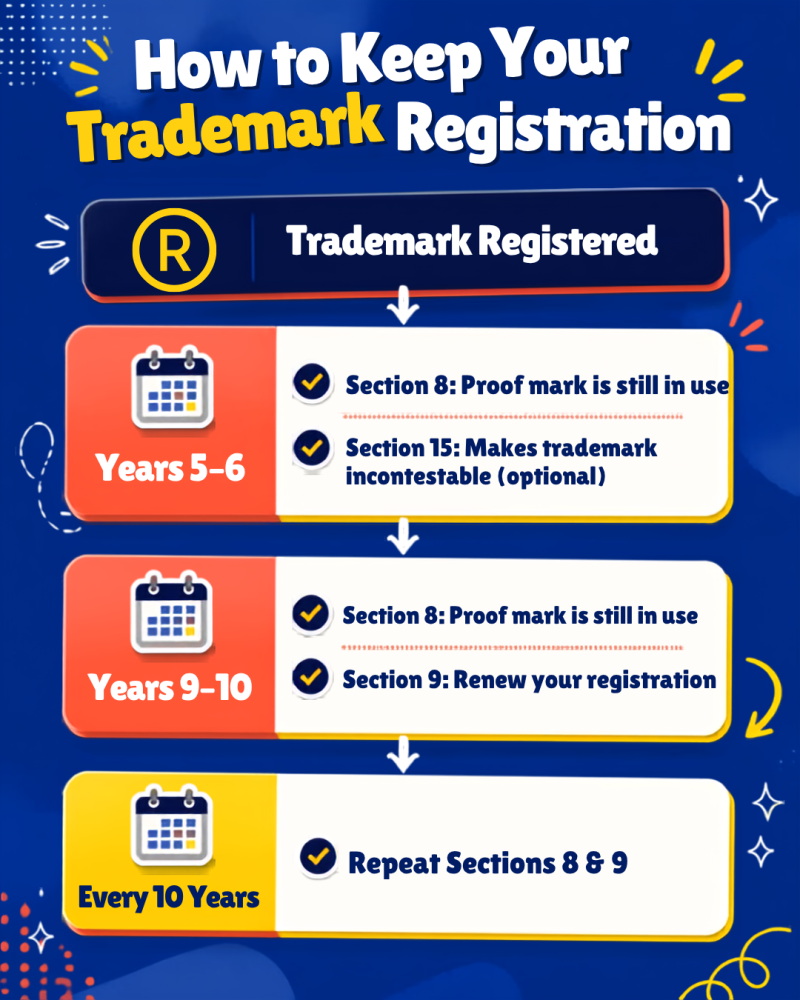
Years 5–6
Your first major deadline comes between the fifth and sixth year after your trademark is registered. During this time, you are required to file what is called a Section 8 Declaration. Do not let the legal name make it sound complicated. You are basically showing the USPTO that you are still using your trademark in your business. For example, if you registered your business name for a clothing brand, you may need to provide an example showing that you still sell clothing under that name. This filing is important because the USPTO does not simply assume that you are still using your trademark five years later. If you do not file the required Section 8 Declaration within the deadline or available grace period, your registration can be canceled.
This time period is also when you should consider filing a Section 15 Declaration of Incontestability. Unlike Section 8, Section 15 is not mandatory. You do not need to file it to keep your registration active, but is very valuable to have.
Section 15 can give your trademark registration stronger protection. If you have continuously used your registered trademark for at least five years and meet the other requirements, you may be able to file Section 15 and make your trademark “incontestable.”
In simple terms, this makes it harder for someone to challenge your trademark registration. Certain arguments that could have been used against your registration may no longer be available. It can also make it easier to prove that your trademark is valid and that you have the exclusive right to use it for the goods or services listed in your registration.
This does not mean your trademark can never be challenged. There are still certain reasons an incontestable trademark can be challenged, such as if the trademark has been abandoned or becomes generic. However, Section 15 gives eligible trademark owners an extra level of protection that can be very valuable if a dispute happens in the future.
This is why Sections 8 and 15 are often filed together. Section 8 is to keep your trademark registration active, while Section 15 provides additional legal protection by making your registration harder to challenge.
Years 9–10
The next major deadline comes between the ninth and tenth year after your trademark is registered. During this period, you need to file Sections 8 and 9 with the USPTO.
Just like in years 5–6, Section 8 is back. Once again, the USPTO wants to make sure you are still actively using your trademark. Section 8 confirms that you are still using the mark, while Section 9 renews your registration for another 10 years. Once you complete this renewal, your next renewal is due 10 years later. You will continue filing Sections 8 and 9 every 10 years for as long as you actively use the mark.
Remember the two important deadlines, Years 5–6 and Years 9–10. After that, remember to renew every 10 years.
Getting your trademark registered takes time, money, and patience. Do not let all of that work go to waste by missing a deadline. Continue using your trademark, and stay on top of the required filings. A trademark can last forever, but only if you take the steps necessary to keep it alive.