
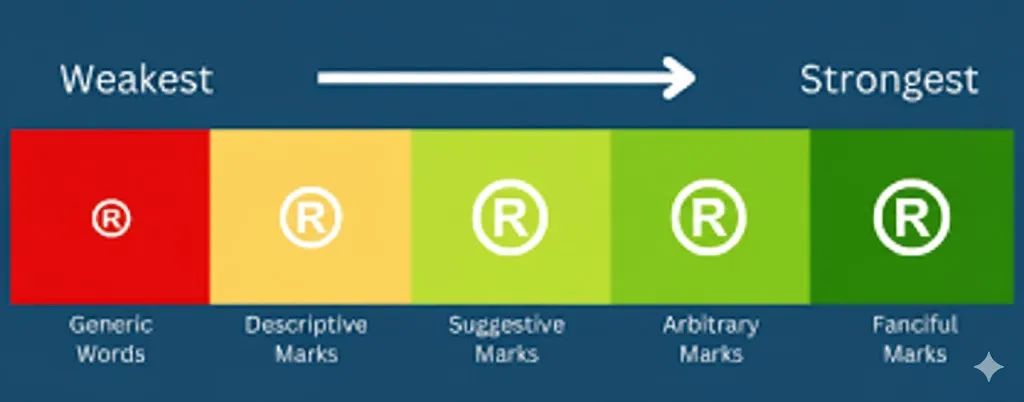
Tiers of distinctiveness for trademarks. From least likely to most likely to be registered.
If you start a business, your name is everything. It is the first thing people see, but there is one aspect that many new business owners do not realize. Trademark registrations are not given out to everyone. Just because you file the application does not mean your name will be registered. Think of your business name like a house. The stronger the foundation, the harder it is for someone to knock it down. The goal is to pick a name that not only sounds great but also stands strong when it comes to trademark protection. Every name falls into one of the five levels of “trademark strength.” Let’s start from the weakest and work our way up.
If you start a business, your name is everything. It is the first thing people see, but there is one aspect that many new business owners do not realize. Trademark registrations are not given out to everyone. Just because you file the application does not mean your name will be registered. Think of your business name like a house. The stronger the foundation, the harder it is for someone to knock it down. The goal is to pick a name that not only sounds great but also stands strong when it comes to trademark protection. Every name falls into one of the five levels of “trademark strength.” Let’s start from the weakest and work our way up.
Generic names are at the bottom. These are words everyone uses to describe a product or service, like “Computer Store” for a shop that sells computers or “Band-Aid” for an adhesive bandage. You cannot register these because the name has become so common that people now use it to describe the entire type of product.
Next are descriptive names. These describe what your business does or a feature of your product, like “California Pizza Kitchen” for a pizza restaurant or “Cold and Creamy” for ice cream. These names can only be registered after you have used them long enough to develop a “secondary meaning.” A “secondary meaning” is where consumers associate your business name because of your consistent use and advertising.
The middle level is For example, “Netflix” suggests movies (“flicks”) on the internet, and “Jaguar” makes you think of speed. These names make people think a little bit more because they hint at a product’s qualities or characteristics without explicitly describing them. This requires the consumer to use imagination to make the connection.
Then comes arbitrary names. These use real words that have nothing to do with what you sell. For example, “Apple” for computers or “Dove” for soap. They stand out because they are unexpected and force consumers to make a mental leap to connect the two.
At the top are fanciful names. These are made-up words that did not exist before the brand created them, like “Kodak” and “Google.” They are unique, memorable, and the strongest kind of trademark protection you can get.
So how do you choose? Stop using boring words or names that other people might pick. Your name needs to be clever, a little surprising, or maybe even a word you make up entirely! The more your name stands out, the stronger your brand becomes. Ultimately, the goal is to make sure your name can be registered and that you have positioned yourself in the best way possible to make that happen.