
Athletes today are no longer just competing for minutes, stats, or wins. They are building audiences, shaping identities, and becoming their own brands. Many athletes are constantly on the national stage, which can open doors to partnerships, businesses, speaking opportunities, media careers, and life after sports. For many athletes, a strong personal brand is no longer optional. It has become one of their most valuable assets. This shift raises an important question, when does an athlete’s personal brand become something that should be legally protected? Not every athlete needs a trademark, but for many, owning and protecting their brand can be incredibly beneficial.
A trademark is legal protection for a name, phrase, or logo that represents a brand. For athletes, a trademark means owning the words or designs people associate with you when they are used to sell or promote a good or service. It gives you the right to control who can put your name or phrases on products, use them in advertising, or build businesses around them. Without a trademark, almost anyone can legally sell merchandise or run promotions tied to your identity. A trademark puts that control back in the athlete’s hands.
What is often forgotten is that trademark registrations become powerful through licensing, which allows a company to use a protected name, phrase, or logo in exchange for payment while the athlete keeps ownership.
Most athletes do not walk onto campus needing a trademark. A shift occurs when an athlete stops being “just a player” and begins to be publicly recognized. At that point, a name starts to carry weight, and an identity becomes something people remember, follow, and support. That shift is subtle, yet powerful. This is the point where filing a trademark moves from optional to strategic.
Azzi Fudd is the perfect example of smartly filing trademarks that fit her brand. On the court, she has become one of the most visible players in women’s college basketball. As a guard at UConn, she has spent her career on national television, deep in March, and in championship conversations. This past season, she played a major role in UConn’s national title run and earned Most Outstanding Player honors at the Final Four. She averaged around 17 points per game, shot efficiently, and continued establishing herself as one of the faces of the sport.
Azzi Fudd's mother wearing "Fudd Around and Find Out" which Fudd later filed a trademark for. This shows times where athletes should file trademark applications.
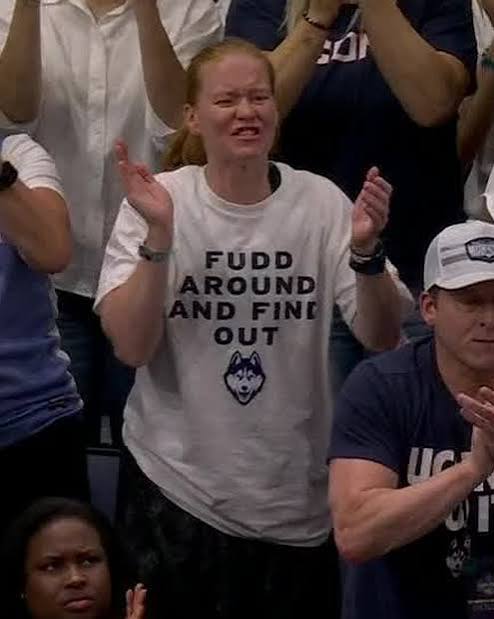
During last year's NCAA Tournament, one of the most talked-about moments involving Fudd had nothing to do with her game. Her mother appeared wearing a shirt that said, “FUDD AROUND AND FIND OUT.” The phrase was funny, clever, and instantly memorable. It quickly gained traction across broadcasts and social media, as fans shared the image and repeated the phrase. What began as a lighthearted joke soon developed into something more. The phrase became a recognizable brand asset tied directly to Fudd’s identity.
Azzi’s official merchandise now includes branding tied directly to her identity, including “FUDD AROUND AND FIND OUT,” “AZ35,” and “THE PEOPLE’S PRINCESS.” These phrases are not random. Each one connects back to her name, her story, and her presence in the sport, triggering recognition the moment people see them. That reaction is exactly what effective branding is meant to do. This recognition carries real commercial value, and trademark registrations exist to protect that value when it is used in business.
What makes Azzi’s trademark strategy especially strong is what the filings actually cover. Her applications are not limited to one narrow product. Instead, her marks are filed across multiple classes (categories), including clothing and merchandise, business and promotional services, and entertainment and athletic-related services. In simple terms, her brand is positioned not just for T-shirts, but for broader commercial use tied to who she is as an athlete and public figure. Her “AZ35” and “THE PEOPLE’S PRINCESS” marks are filed in connection with apparel, marketing services, and entertainment-related services. Her “AZZI FUDD” mark extends even further, covering areas such as collectible trading cards, merchandise, promotional services, and sports-related appearances. Her “FUDD AROUND AND FIND OUT” filing protects the phrase for branded apparel and entertainment use. Without this type of protection, another party could attempt to register or commercialize these ideas first, potentially limiting how she could use her own brand. This approach allows her brand to grow beyond basketball, giving her the ability to expand into different products, partnerships, events, and media opportunities.
Fudd’s filings reflect a smart brand strategy and an understanding of how quickly recognition turns into opportunity. She moved when her name, phrases, and identity were gaining attention. That timing matters. Once branding becomes recognizable, outside parties often try to use it, copy it, or build around it. Athletes who delay protection risk losing control of ideas, slogans, and brand elements they created. Many athletes would benefit from the same approach: recognizing when their brand is gaining traction and securing it before someone else does.